Fellow Servant-Warriors:
We had yet another great turnout at last week’s FCPO-Denver chapter meeting (essentially our weekly “cop church” service) where our focus was on the topic of killing and whether or not the taking of a human life by law enforcement and military personnel is biblically justified. Many officers who have a rudimentary knowledge of Scripture are in fact confused about this issue. As such, I wanted to both clear up any misunderstanding while at the same time providing a concise tool for us to us when sharing with others on this subject. Accordingly, please take the time to review the RECAP I’ve posted below.
We are in fact meeting at our regular place and time this coming Thursday, November 4th, and I’ve posted the most up-to-date local meeting schedule here on our website (see posts below this one) along with the latest prayer requests and announcements. Please join us in taking these requests to God in prayer -- and don’t forget to check back frequently for the latest updates. Also note the two new posts regarding brother officers who are very much in need of your prayers and financial assistance.
As a follow-up to last week’s study, this Thursday we’ll dig into God’s view of law enforcement and the military as detailed in His perfect “policy and procedure manual,” the Bible. As always, I’ll present a detailed recap in next week’s newsletter and on the website. Stay tuned or join us in you’re in the Denver metro area.
Don’t forget to VOTE!!
There are many who consider tomorrow’s (11/2) election to be one of the most important in our nation’s history. While I can't tell you whom to vote for, may I humbly suggest that you take the time to study the issues through a biblical lens and then vote in alignment with that biblical worldview. I’ve taken the liberty of presenting the following to help you think further on the issues facing our country. Moreover, be in prayer for our nation in accordance with II Chronicles 7:14 – If my people, who are called by my name, will humble themselves and pray and seek my face and turn from their wicked ways, then I will hear from heaven, and I will forgive their sin and will heal their land.
(1) Food for thought from retired Gen. William Boykin:
http://www.morningstartv.com/oak-initiative/marxism-america
(2) http://www.youtube.com/watch_popup?v=XNUc8nuo7HI
Thou shalt not KILL?? The RECAP!
The phrase the "Ten Commandments" -- aka "The Law," refers to God’s lovingly-invoked prohibitions in Exodus 20 and Deuteronomy 5. In particular, we are going to take a close look at what is generally called the “6th Commandment” as found in:
Exodus 20:13
Thou shalt not kill (KJV) vs. You shall not murder (NKJV).
and
Deuteronomy 5:17
Thou shalt not kill (KJV) vs. You shall not murder (NKJV).
To be clear, the use of the English word “kill” by the original King James Version (KJV) translators and in the Roman Catholic translations is not altogether “wrong” but rather fails to properly denote God’s intended context and meaning. There are in fact seven different Hebrew words for “kill” or “killing” but the one used in Exodus and Deuteronomy is correctly translated as denoting “MURDER” in modern English. The word is also correctly translated from Hebrew to Greek in Matthew and James as MURDER as opposed to “kill.” Specifically, modern Bible translators point to two Hebrew words -- mut and ratsakh -- and two Greek words – apokteino and phoneus, that mean “murder” and “kill,” respectively The first words in each language mean “to put to death” while the latter mean “to murder.” It is the latter words that are specifically prohibited by God in the Ten Commandments and not the former. Moreover, the Hebrew word ratsakh (murder) has a broader definition in that it includes deaths due to carelessness or neglect but never to describe killing during times of war or “in the line of duty.” It is for this reason that most modern translations (New King James Version – NKJV – for example) correctly render the Sixth Commandment “You shall not murder” rather than “You shall not kill.” If the KJV meaning of “Thou shalt not kill” was just that -- no killing -- it would literally mean that God -- and visa vie the Nation of Israel -- would be violating His own commandment (which is of course impossible -- see also God’s “rules of war” in Deuteronomy 20). Rather, the word properly denotes only the illegal, unjustified taking of another human life.
The well-known Hebrew scholars C.F. Keil and Franz Delitzsch write:
Accordingly, in the command, “Thou shalt not kill,” not only is the accomplished fact of murder condemned, whether it proceed from open violence or stratagem, carelessness (Deut. 22:8), wantonness (Lev. 19:14), or from hatred, anger and revenge (Lev. 19:17,18)... The prohibition includes not only the killing of a fellow-man, but also the destruction of one’s own life (suicide).
Therefore perhaps an alternative translation that could properly include the word “kill” would be, “You shall not kill unjustly.”
Clearly, those of us serving in the armed forces (military, law enforcement, etc.) and those lawfully protecting themselves and/or others from imminent deadly force do not commit “murder” as defined. Throughout the OT, God repeatedly “took out” His enemies and those of His people – and (again) He CANNOT go against His own word! In addition, our signature passage from Romans 13:1-7 reveals that we are in fact ordained by God to execute wrath (deadly force, death penalty, etc.) on His behalf and that of the government for His glory and the protection of His people. Contextually, you have to realize that when Paul wrote Romans, he was writing to Christians who were under the authority of Roman law as enforced by the police officers of their day -- the Roman Legion (from which we get the rank of Centurion).
God has given us an awesome mandate – a policy even – that authorizes and directs us to use lawful lethal force in times of war, in defense of ourselves and others when legally justified in doing so, AND to carry out the death penalty in accordance with the rule of law (killing as opposed to murder). By the same token, we must also view murder as God does – that it is not just the illegal, unjustified killing of another but that it also includes the condition of one’s heart towards another.
Matthew 5:21-26 reveals that our Lord places unjust anger on same plane as murder.
James 2:11 says For He who said, “Do not commit adultery,” also said, “Do not murder.” Now if you do not commit adultery, but you do murder, you have become a transgressor of the law.
1 John 3:15 further elaborates on what James wrote: Whoever hates his brother is a murderer, and you know that no murderer has eternal life abiding in him.
Our friends with http://www.gotquestions.org/ write,
Many people mistakenly look at the Ten Commandments as a set of rules that, if followed, will guarantee entrance into heaven after death. In contrast, the purpose of the Ten Commandments is to force people to realize that they cannot perfectly obey the Law (Romans 7:7-11), and are therefore in need of God’s mercy and grace. Despite the claims of the rich young ruler in Matthew 19:16, no one can perfectly obey the Ten Commandments (Ecclesiastes 7:20). The Ten Commandments demonstrate that we have all sinned (Romans 3:23) and are therefore in need of God’s mercy and grace, available only through faith in Jesus Christ.
*NOTE: http://www.godquestions.org/ served as a primary reference for much of our study.
Finally, our own Erv Meyer writes, "Because God gives life, He is the One who should say by whom, when, where, and how a life is ended. Romans 13 says that lawful killing is both a privilege and an awesome responsibility given by God to those he ordained for same (law enforcement, military) and for lawful self-defense. On the other hand, Mark 7:21-23 says murder (the Greek word apokteino) is an evil thing that comes from the heart. Murder is when man usurps God's exclusive right and ends a life for wrong, foolish or selfish reasons. It's good that lethal force comes under careful scrutiny. This underscores the importance of being a committed Christian. A less than totally committed Christian may find himself inadequately prepared to make the right decision to choose to serve God rather than serve self or obey a wrongful order from man. We can be servants of God to kill, but we are never to serve ourselves (or others) to murder."
So how about you? Have you ever committed murder in your heart? What about ongoing, unrepentant and biblically unjustified anger towards a “brother” (not just the blood relative kind)? If so, you can humbly come to God TODAY, repent and receive His forgiveness and peace. Is your heart right with God? If not, then seek Him now – He is faithful to forgive and to save! See http://www.fcpo.org/christian.html for more!
Until next week – let’s stay in the word (Bible), in prayer and in step with our perfect Commander-in-Chief, Lord and Savior. Blessings!

The CENTURION Law Enforcement Ministry


About Us
- MC Williams
- Littleton, Colorado, United States
- The Centurion Law Enforcement Ministry (TCLEM) is a Christian outreach to/for/about law enforcement personnel and their families. Our vision is to WIN LEOs to a saving faith in Jesus Christ, DISCIPLE the Christian officer, and then SEND them out to boldly live and share their faith at home and in the workplace. In doing so we also seek to increase morale and reduce our high rates of suicide, depression, divorce, alcoholism and related issues. In addition to a weekly e-newletter and website, TCLEM's local FCPO chapters (FCPO-Denver and FCPO Castle Rock) meet regularly in the Denver and Castle Rock (CO) area for profession-relevant Bible study, prayer and fellowship. TCLEM and FCPO-Denver is led by Chaplain M.C. Williams, a 30-year law enforcement veteran (patrol, SWAT, training, investigations, etc.) concurrently serving as a State Criminal Investigator (detective), Police Chaplain and retired Police Lieutenant. In addition to being a police and ministry leader, author and speaker, MC is the current FCPO national board VP and is a sought-after conference and event speaker. Feel free to contact MC for further details.
Lt. (Ret.) M.C. Williams

Who says you can't be a cop and chaplain at the same time?
Williams, Grossman and Glennon
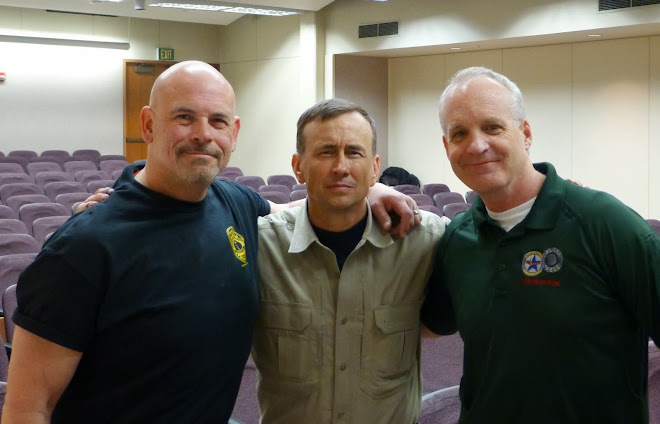
Denver Bulletproof Warrior Seminar
FCPO Police Mission Team -- Moldova 2012

Team at Orheiul Vechi
Servant-Warriors for Christ

Engage in the Fight
National Law Enforcement Memorial

Note the verse below the lion...
Ten-Four Ministries Tulsa Bulletproof Mind Event

Cpt. Travis Yates, Lt. Col. Dave Grossman, and Yours Truly in Tulsa
Lt. Col. Grossman and Future Warrior

Dave and newest member of the Yates family
With Lt. Col. Dave Grossman

Yours Truly, Dave, and DPD Sgt. Jim Mair
TCLEM/FCPO-Denver at Top Gun Police Motors Comp

MC, Mike Carter, and "the Hog" in the background
Centurion Ministry/FCPO-Denver

FCPO Charter Night
Det. Sgt. (now Lt.) and Chaplain MC Williams

Another winter day in the Colorado high country
FCPO-Denver Baptism Service

Jimmy Wattles being baptized by MC
Wounded Polk Co. (WI) Dep. Mike Seversen and I

Christmas Eve visit at Craig Hospital
Centurion Ministry t-shirt and the ministry Harley

Dep. Chris Dewey Remembered

Col. Ray Fairman with Kyle Mair at TCM Study
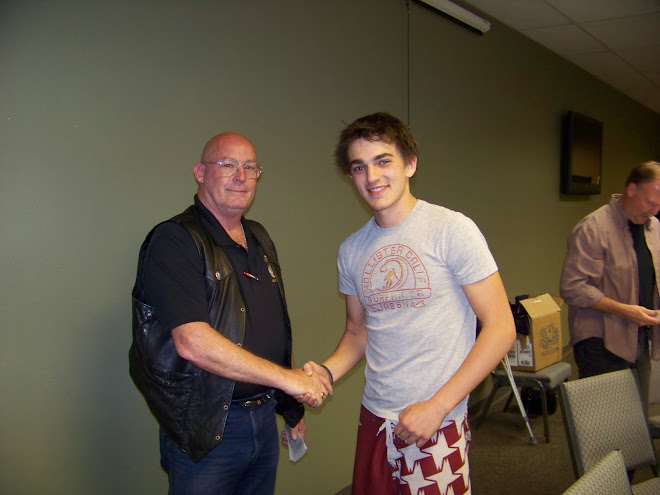
Marine Corps Past Mentors Marine Corps Future
TCLEM Meeting in Denver
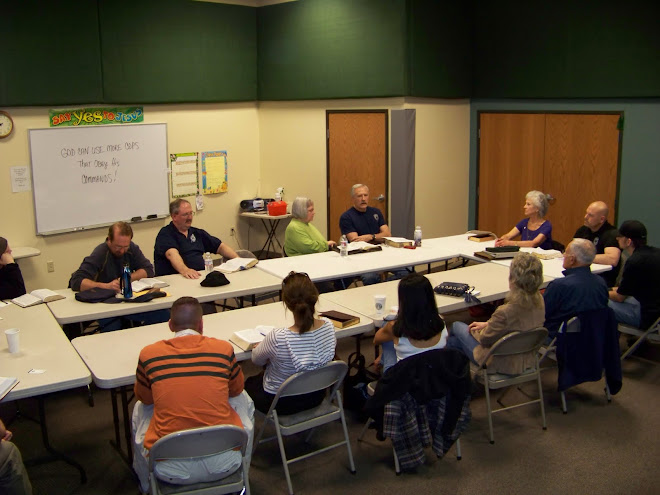
Inv. Jim Wattles Shares a Point
The Late Sgt. Joe Harris (Sandoval Co. SO, NM) at the National LE Memorial

Joe was killed in the LOD after this visit. Never forget!
NMSP Raid

My SID warrant team
The Whole Armor of God

The Christian Officers Armor: Ephesians 6:11-17
God's Warriors

From a CPD Brother
Warrior in Prayer

Warriors in Fellowship

The First Non-Jewish Christian

Cop at the Cross